
Firefighters and researchers from IMDEA at the European Researchers’ Night in Madrid 2026
September 29, 2026
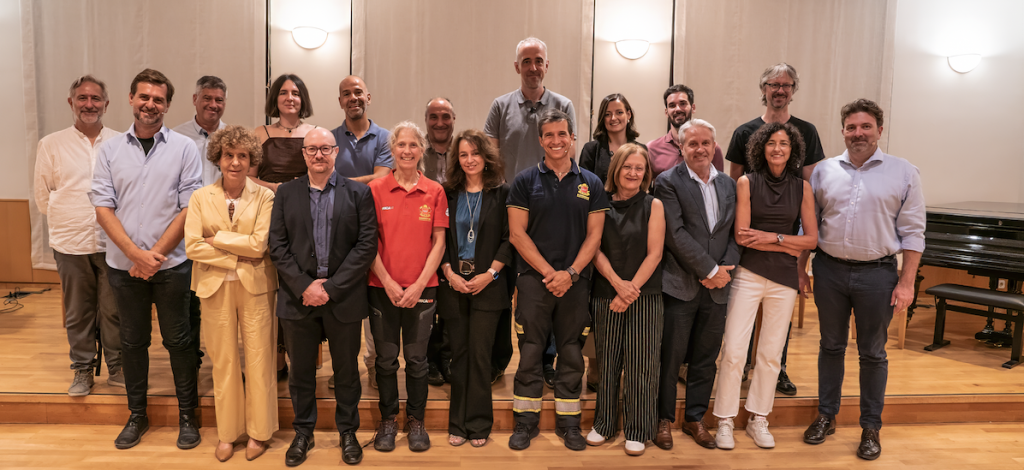
Celebrating the Madrid European Researchers’ Night at the Residencia de Estudiantes de Madrid is always a pleasure. And doing so accompanied by the Community of Madrid firefighters is truly amazing!
And that is what we, the seven IMDEA institutes, did at the 17th edition of this project, the European Researchers’ Night, coordinated in Madrid by the Fundación para el Conocimiento madrimasd.
When we announced that we, the seven IMDEA Institutes, were going to organise the activity Science in the Face of Natural Disasters, we wrote that “Science is vital to prevent catastrophic situations or to mitigate their most negative effects once they have occurred”. And what the IMDEA researchers and the firefighters of the Community of Madrid told us last Friday, 25 September, confirmed it.
Thanks to Annika Coll and Agustín de la Herrán, the firefighters who joined us, we learned what it means to travel to the other side of the world to help the survivors of an earthquake or to put out the largest fire our region has ever suffered, when everything that should work, such as communications or the supply of electricity, food or water, fails. Or that the firefighters of the Community of Madrid already have a great deal of technology that helps them protect others and protect themselves; but they would like to have much more.
And thanks to Mario Ballesteros (IMDEA Water), Milan Prodanovic (Energy), Jimena de la Vega (Materials), José Sánchez Costa (Nanoscience), Carlos Jesús Bernardos (Networks), Cristina María Fernández (Nutrition) and José Aguilar (Software), who at IMDEA are carrying out research to make Annika and Agustín’s wish come true.
For example, José Aguilar does so through a project in which they develop 3D models of the land that identify land uses, vegetation type, terrain relief, humidity, etc. They use these models to recognise potential risks, such as the volume of water in a ravine depending on the amount of rain and where it falls; to suggest safe access and evacuation routes; or to assess the effect of specific interventions such as reforestation, diverting a watercourse,…
Mario Ballesteros explained that his group studies how different climate change scenarios affect human and environmental systems. They seek to understand what would happen to economic activity and to the environment if extreme events such as droughts, floods or fires became more frequent or more intense. They are also able to identify where risk and potential damage from floods, fires, river surges… are concentrated, and to assess possible preventive measures.
Cristina Fernández and José Sánchez talked about protecting those who protect us. In Cristina’s case, through precision nutrition, with which they try to understand, using cutting-edge science, how what we eat affects our body and our health. To do so, they rely on state-of-the-art molecular techniques. In the case of special corps such as firefighters, who work in extreme conditions of heat, physical exertion and stress, they aim to go beyond generic recommendations and arrive at something personalised to each individual’s molecular profile, in order to improve their physical and mental resilience, among other things.
In José’s case, at IMDEA Nanoscience they work at such an extremely small scale, the nanoscale, that it allows them to do something brilliant: “program” matter so that it does things that previously seemed impossible. Specifically, his group researches switchable materials, which work like molecular switches. When they sense an external stimulus, they are able to radically change their physicochemical properties: their colour, their magnetism or their structure, reversibly. That “stimulus” can be a change in temperature or direct contact with a specific gas.
Jimena de la Vega talked about materials on a larger scale. Materials for construction, for electric batteries, for… Jimena believes it is possible to move towards safer and less toxic materials, and she gave examples of projects they are developing to achieve this, such as one working with ultralight materials obtained from seaweed waste, which can act as thermal insulators and improve fire resistance. Or the line of work on manufacturing fire-resistant batteries, which designs new materials for battery casings and modifies the components they are made of.
And Carlos Jesús Bernardos and Milan Prodanovic talked about securing communications and the power supply. Carlos Jesús believes that future mobile networks will be able to act as a large network of sensors capable of detecting changes in temperature, smoke or other anomalies before a fire becomes visible or an earthquake strikes, for example. The idea is aligned with one of the most recent research topics: integrated sensing and communications, a technology based on trying to leverage existing communication devices in order to “sense” the environment. This has multiple applications, from detecting that a dependent person or someone with special needs has fallen at home (without cameras), to anticipating potential disasters or threats by leveraging existing communication infrastructure.
Milan focused on explaining how the power supply can be secured or improved after a disaster, although he stressed that it is essential to work before the disaster occurs, ensuring the resilience of power grids and making changes to grid planning and operation. He talked about emerging technologies such as grid-forming converters, which act as voltage sources capable of autonomously setting the amplitude, phase and frequency of a power grid, which gives them a fundamental capability to start up in the dark, from scratch (black-start), without relying on a prior signal.
We said goodbye with a phrase that all the participants repeated at the end of the coffee talk: we will keep doing things together, because there are many areas in which we can contribute to one another.